
You might have been told to mention your osteoporosis medicine before dental work, then found advice online that left you more worried. Does it rule out an implant? Should you change your next appointment? What does the dentist actually need to know?
Osteoporosis medicines can change the assessment and planning needed before a dental implant; they do not provide a yes-or-no answer on their own. Healthy Bones Australia’s March 2026 guidance calls for individual assessment and coordination with your prescriber. At South Perth Dental Surgery, implant consultations begin with your medical and dental history. [1] [2]
Summary of the article
- Bring your previous osteoporosis medicines as well as your current prescription. A change of medicine does not make the earlier treatment history irrelevant.
- The assessment considers your health and the proposed dental procedure together, including where surgery would take place.
- Do not stop, skip or reschedule osteoporosis medicine yourself to prepare for dental work. Ask your dentist and prescriber to coordinate the plan.
- A consultation is a place to discuss suitability, alternatives and risks before deciding on treatment. [1] [2]
Why does my osteoporosis medicine matter to an implant discussion?
Some osteoporosis medicines are associated with an uncommon but potentially serious jaw-healing complication, so your dentist needs to know exactly what you take. The complication is called medication-related osteonecrosis of the jaw, usually shortened to MRONJ. It can involve exposed or affected jawbone and may require specialist care. [1]
The March 2026 Australian consensus discusses medicines that reduce bone turnover, including bisphosphonates and denosumab. MRONJ can occur after an extraction or implant placement, although a preceding surgical procedure is not always present. It is a particular complication to discuss, rather than another name for every implant problem. [1]
Your bone health still matters throughout this conversation. Osteoporosis makes bones more fragile, and its treatment aims to reduce fractures. The dental plan needs to account for both jaw-healing concerns and the reason your doctor prescribed treatment. Neither should disappear from the discussion. [1] [3]
You do not need to work out your own risk category before making an appointment. Bring the information you have, including anything you are unsure about, and ask the clinicians to explain what it means for your situation.
What information should I bring?
Bring a medicine history that covers earlier treatment, recent doses and your prescriber’s details, not just the name on today’s prescription. Healthy Bones Australia’s 2026 statement specifically says cumulative treatment time needs consideration when someone has switched between bisphosphonates and denosumab. [1] (page 3)
That distinction is easy to miss. If you changed treatment, say so, even if you cannot remember the exact date. Write down what you do remember and flag the gaps rather than guessing. An old prescription list, a photograph of the medicine packaging or a note from your medical team may help you explain the history.
| Information to bring | What to write down or ask about |
|---|---|
| Current osteoporosis medicine | The name, how it is given and the prescribed schedule. Bring the label or your medicine list if the name is unfamiliar. |
| Previous osteoporosis medicines | Earlier tablets, injections or infusions, approximately when you used them and when you changed treatment. |
| Recent and upcoming treatment | Your last treatment date and the next planned date, if known. Give the dates to the clinicians rather than adjusting them yourself. |
| Prescriber details | The name and contact details of the GP or other clinician managing your osteoporosis. |
| Other health information | Your full medicine list, relevant medical conditions, smoking history and any recent fracture. |
| Dental concerns | Pain, gum problems, previous healing difficulties, a denture that rubs, or an existing treatment plan. |
This is an appointment-preparation list, not a scoring system. Its clinical basis is the 2026 statement’s assessment of medicine exposure, health, oral condition and planned surgery. Your dentist may need further information after examining you. [1] [2]
Why do the location and extent of surgery matter?
The proposed procedure matters because the 2026 guidance assesses procedure-related factors alongside patient-related factors. Two people taking the same medicine may therefore need different dental planning. [1]
The statement distinguishes uncomplicated implant placement from more extensive surgery and identifies the back of the lower jaw, the posterior mandible, as a procedural consideration. It also considers the extent of the surgical area. This is more specific than asking whether implants are generally possible with osteoporosis. [1] (page 4)
Your health and mouth are the other part of the assessment. Factors in the guidance include active dental infection, periodontal disease, poorly controlled diabetes, smoking, poor nutrition and certain other medicines, including glucocorticoids. These factors need interpretation together, not as a checklist that automatically approves or excludes you. [1]
A useful question is: “Which part of my medical history and which part of the proposed procedure affect the plan?” Ask whether an extraction or additional procedure would be involved, too. You should not have to infer the treatment plan from the word “implant” alone.
Should I stop my medicine before the appointment?
Do not change your osteoporosis treatment yourself to prepare for a dental appointment or implant procedure. Healthy Bones Australia’s March 2026 consensus states:
“Osteoporosis therapies should not be discontinued without a discussion with the prescribing healthcare provider.”
— Healthy Bones Australia, MRONJ and Osteoporosis, first edition, March 2026, page 2. [1]
The statement says there is no evidence that treatment breaks from osteoporosis drugs reduce MRONJ risk. It also warns that sudden discontinuation of denosumab can cause a rebound increase in bone turnover and painful vertebral fractures. That is why advice to take a routine medication break should not become a plan you follow on your own. [1] (pages 2 and 5–6)
If your next dose and proposed dental appointment are close together, give both dates to your dentist and prescriber. Ask them to coordinate any timing decisions and explain the agreed instructions. This article does not set a treatment interval or tell you when to move a dose.
Older online advice can be confusing because it may discuss medication breaks without the same qualifications. The current Australian statement acknowledges inconsistent international advice and calls for individualised discussions between the dental and medical clinicians. [1]
What if I haven’t started osteoporosis treatment yet?
Tell your prescriber about planned dental work and tell your dentist about the proposed osteoporosis treatment, but do not delay either yourself. The 2026 consensus recommends proactive dental assessment and treatment planning before or early in osteoporosis therapy, where possible. [1]
There is an important qualification: awaiting dental review should not unduly delay osteoporosis treatment, particularly when fracture risk is imminent. Equally, osteoporosis medicines should not unduly delay necessary dental intervention. A recent fragility fracture is therefore something to raise with both clinicians, rather than treating dental assessment as a reason to postpone medical care. [1] (page 5)
If you have received different instructions, ask the clinicians to resolve them together. You can say: “My doctor is planning osteoporosis treatment, and I also need dental assessment. Can you explain what needs attention first and coordinate the timing?”
Can a blood test tell me whether an implant is suitable?
A serum CTX result should not be treated as clearance for implant surgery. The 2026 Australian consensus says CTX measurement is not recommended for MRONJ risk assessment because it has no utility in that assessment. [1] (page 6)
You may encounter older webpages that describe CTX testing as a way to estimate jaw risk or decide when surgery can proceed. That is different from the position in the current Australian statement. If someone has suggested the test, ask what clinical question it is intended to answer and how your overall assessment will be made.
The question is still about your medicine exposure, medical and dental condition, and proposed procedure. A test result does not replace that conversation. [1]
What happens at South Perth Dental Surgery’s consultation?
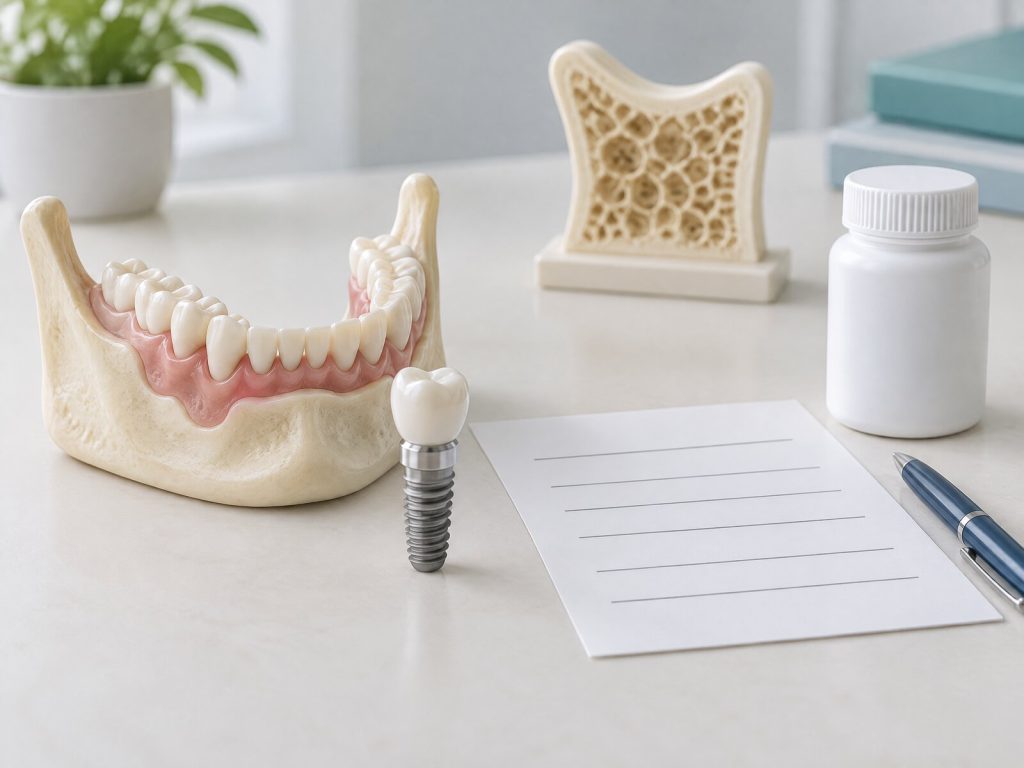
Our published implant consultation information describes four stages: a medical and dental interview, discussion of treatment options, an oral examination and treatment planning. That gives you a practical place to raise your osteoporosis history. [2]
- Talk through your history and concerns. Bring your medicine information and explain what you want help with, whether that is a missing tooth, an existing plan or uncertainty about treatment.
- Discuss the available options. The dentist explains the options, their risks and benefits, and answers your questions.
- Have your mouth examined. The examination covers the teeth, gums, mouth and jawbone. Images, impressions or X-rays may be needed, depending on the assessment.
- Discuss an individual plan. The plan addresses proposed treatment, timing, any additional procedures, what to expect afterwards and costs. [2]
Where MRONJ risk or procedural complexity warrants it, the Australian guidance recommends referral to an appropriately experienced dental specialist and coordination with the medical clinician. A referral is part of planning suitable care, not evidence that every person taking osteoporosis medicine needs specialist treatment. [1]
For background on the separate treatment stages, our article on what happens during a dental implant procedure describes the process. Your own sequence depends on assessment and the plan agreed with your dentist.
What else should I ask before deciding?
Ask about alternatives and the full risk discussion, rather than focusing only on the medicine. Implant surgery can involve infection, nerve or nearby tissue injury, sinus problems and implant failure; MRONJ is an additional consideration where relevant to your history. [1] [4]
South Perth Dental Surgery offers dental implant services and complete and partial dentures. Ask which options are appropriate for you and what their limitations and ongoing care would involve. A listed service is not a recommendation for your mouth. [5] [6]
Take these questions to the discussion:
- What information do you need from my osteoporosis prescriber before a treatment decision?
- How do my medicine history and the proposed surgical site affect the assessment?
- What alternatives should I consider, and what are their risks and limitations?
- Is specialist assessment needed, and who will coordinate it?
- What instructions should I follow, who will confirm the timing, and whom should I contact with concerns?
How can I look after my mouth while planning care?
Keep up oral hygiene and seek early dental assessment for symptoms rather than waiting for an implant decision. The 2026 statement supports brushing with fluoride toothpaste, cleaning between the teeth, regular professional review and attention to denture fit. Your dentist can tailor that advice to your mouth. [1] (page 5)
Tell the dental team about pain, swelling, a sore area, a denture that rubs or healing that concerns you. Do not use an online MRONJ definition or a duration mentioned in a research paper as a reason to wait before asking for help. The guidance calls for early management of dental symptoms. [1] [4]
Arrange a discussion in South Perth
Call 08 9474 2391 or use our contact details to ask about an appointment at 48 Coode St South Perth, WA 6151. Published hours include Saturday, 9am–1pm; please ask the team about appointment availability. [7]
You can say: “I take osteoporosis medicine and would like to discuss a missing tooth. What records should I bring, and can the dentist coordinate with my prescriber if needed?”
Bring your medicine history, prescriber details, any relevant dental records you already have and your questions. The first visit starts with understanding your history and examining your mouth, so the next discussion can be about your actual circumstances. [2]
Sources
Sources checked 2 November 2026. This article explains general published guidance and the clinic’s published consultation process; it is not an individual treatment or medication plan.
- Healthy Bones Australia: Medication-related Osteonecrosis of the Jaw (MRONJ) and Osteoporosis, first edition, March 2026, particularly pages 2–6. Endorsed by the Australian Dental Association and other Australian professional bodies.
- South Perth Dental Surgery: Implant consultations.
- healthdirect: Osteoporosis, last reviewed March 2025.
- South Perth Dental Surgery: Steps during a dental implant procedure.
- South Perth Dental Surgery: Dental implants.
- South Perth Dental Surgery: Dentures.
- South Perth Dental Surgery: Contact details.
