
If your denture moves when you eat or talk, start with a check of the denture you have now. Healthdirect advises seeing your dentist or dental prosthetist if your mouth is sore, or you have bleeding gums, swelling or ulcers, because your dentures may need to be adjusted. [1]
Implants are one possible option for holding a denture in place. Healthdirect describes an implant-retained denture as one fitted onto implants in the jaw, which you can still remove. Before implant treatment, your dental professional checks your bone, gums, medical conditions and medicines. [1] [2]
At South Perth Dental Surgery we offer implant-supported dentures and implant consultations. If your denture is bothering you, contact our team and tell us what is happening when it moves. [3] [4]
Summary of the article
- See your dentist or dental prosthetist if your mouth is sore, or you have bleeding gums, swelling or ulcers; your denture may need adjusting. [1]
- An implant-retained denture fits onto implants in the jaw and can still be removed. [1]
- Before implants, your dental professional checks that you have enough bone, healthy gums, and how your medical conditions and medicines may affect treatment. [2]
- Removable dentures and a dental bridge are alternatives to implants. Ask which option is best for you. [2]
Why does my denture feel loose?
There is more than one reason. A new denture can feel awkward or loose at first, and healthdirect notes it may take a few months to adjust to wearing a new set. [1]
Fit is also checked over time. Once you are used to your dentures, healthdirect advises seeing your dentist or dental prosthetist at least yearly to check they still fit correctly. A denture fitted on the same day as tooth removal, called an immediate denture, may need some adjustments as your gums heal. [1]
So the first question is usually whether your current denture can be adjusted or needs attention. That is something to have checked at an appointment rather than fixed at home.
How does an implant-supported denture work?
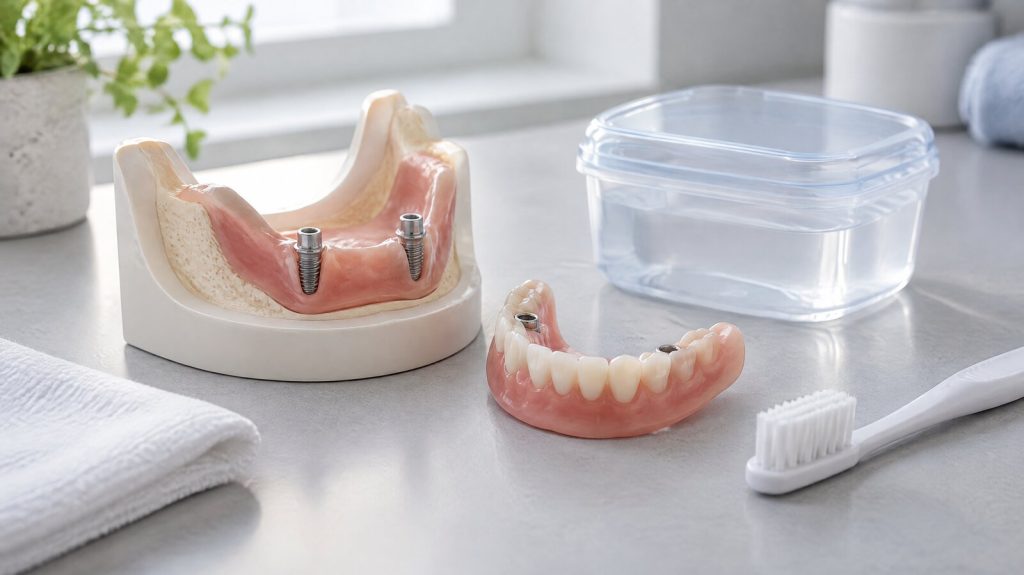
A dental implant is a metal screw, usually made of titanium, that is attached to the bone in your jaw where the roots of a missing tooth sat. An implant can support a crown, a dental bridge or dentures. [2]
Our implant-supported dentures page explains that the implants are surgically placed in the jawbone and, over time, fuse to the bone. They provide an anchor, and the denture is made to attach to them. [3]
This type of denture can still be removed. Our page advises taking implant-supported dentures out at night to give your soft tissues a chance to rest, and healthdirect gives the same overnight advice for dentures generally. [3] [1]
What do we check before suggesting implants?
Implants are not right for everyone. Before you have a dental implant, healthdirect says your dental professional will check: [2]
- you have enough bone to hold the implant
- any medical conditions you have
- any medicines you take
- your gums are healthy.
Some conditions can affect the health of your jawbone or raise the chance of an infection or another complication. Healthdirect lists being over 60, osteoporosis, cancer, a bleeding disorder, gum disease, diabetes and smoking as things to tell your doctor about. [2]
At an implant consultation with us, the dentist asks about your dental and medical history and your goals, and examines your teeth, gums and jaw bone. Images, impressions and X-rays may be taken. The dentist then explains the options available to you, with the risks and benefits of each, and may discuss costs once a treatment plan is agreed. You can read more about the visit on our implant consultation page. [4]
What does treatment involve, and what are the risks?
Implant treatment is usually done in stages over a few months. You have X-rays first, then the implant is put into your jawbone in a minor operation under local anaesthetic. Over about 3 months the bone grows around the implant, and the denture is then attached. [2]
After the procedure you might have bruising, pain, swelling of your gums or face, or bleeding from your gums; ask your dental professional for advice if this happens. Possible complications include infection, nerve damage, sinus problems and injury to surrounding teeth. [2]
Take time to ask questions before surgery. Healthdirect explains that your dental professional needs to explain your options so you can give informed consent. If you notice swelling around an implant later on, our article on swelling around a dental implant explains when to call. [2]
What are the alternatives?
Healthdirect lists wearing dentures that you can remove, or having a dental bridge attached to your surrounding teeth, as alternatives to a dental implant. It describes three main types of denture: a full denture that rests on your gums, a partial denture held in place by metal clasps around your remaining teeth, and an implant-retained denture. [2] [1]
If your current denture can be adjusted or remade, that may meet your needs. Ask your dental professional which option is best for you. Our dentures page covers complete and partial dentures, and our earlier article on whether dental implants are right for you has more questions to think about. [2]
How much does it cost?
A dental implant can be expensive, so healthdirect recommends knowing all the costs before you start. Your dental professional can explain the costs and give you a quotation. If you have private health insurance, find out whether it covers some of the cost. [2]
Our implant-supported dentures page explains that the final cost depends on factors such as the number and type of implants needed and whether you need additional work like bone grafting. An implant consultation is the way to get an accurate quote. See our payment options for ways to pay. [3]
How do I look after an implant-supported denture?
Always remove your denture to clean it. Healthdirect advises using a soft toothbrush on all surfaces, and suggests mild soap and water because toothpaste can scratch denture surfaces. Brush your gums and tongue every day and keep up regular dental checks. [1]
Our implant-supported dentures page lists signs that the denture may need adjusting: it feels loose, you can see gaps between your gums and the denture, it causes pain or discomfort, or you have difficulty eating or speaking. If you notice any of these, contact your dentist for an examination. [3]
When should I book an appointment?
Book a check if your denture moves when you eat or talk, rubs, or is hard to use. See your dentist or dental prosthetist if your mouth is sore, or you have bleeding gums, swelling or ulcers. [1]
Contact South Perth Dental Surgery on 08 9474 2391. The clinic is at 48 Coode St, South Perth, WA 6151. You can also use our appointment page to book an implant consultation or a denture check. [5]
Author: Dr. Shahid Qureshi (General Dentist), South Perth Dental Surgery.
Sources
Sources checked 16 November 2026. This is general information for people with dentures, not a diagnosis or a personal treatment plan. An examination is needed before anyone can advise whether implants suit you.
- Healthdirect Australia: Dentures — types, fitting, care and when to see your dentist.
- Healthdirect Australia: Dental implant procedure — checks before treatment, stages, recovery, complications, alternatives and costs.
- South Perth Dental Surgery: Implant-supported dentures — how they attach, care and signs they need adjusting.
- South Perth Dental Surgery: Implant consultations — what happens at the visit.
- South Perth Dental Surgery: Contact details.
- South Perth Dental Surgery: Dr. Shahid Qureshi — general dentist profile.
